



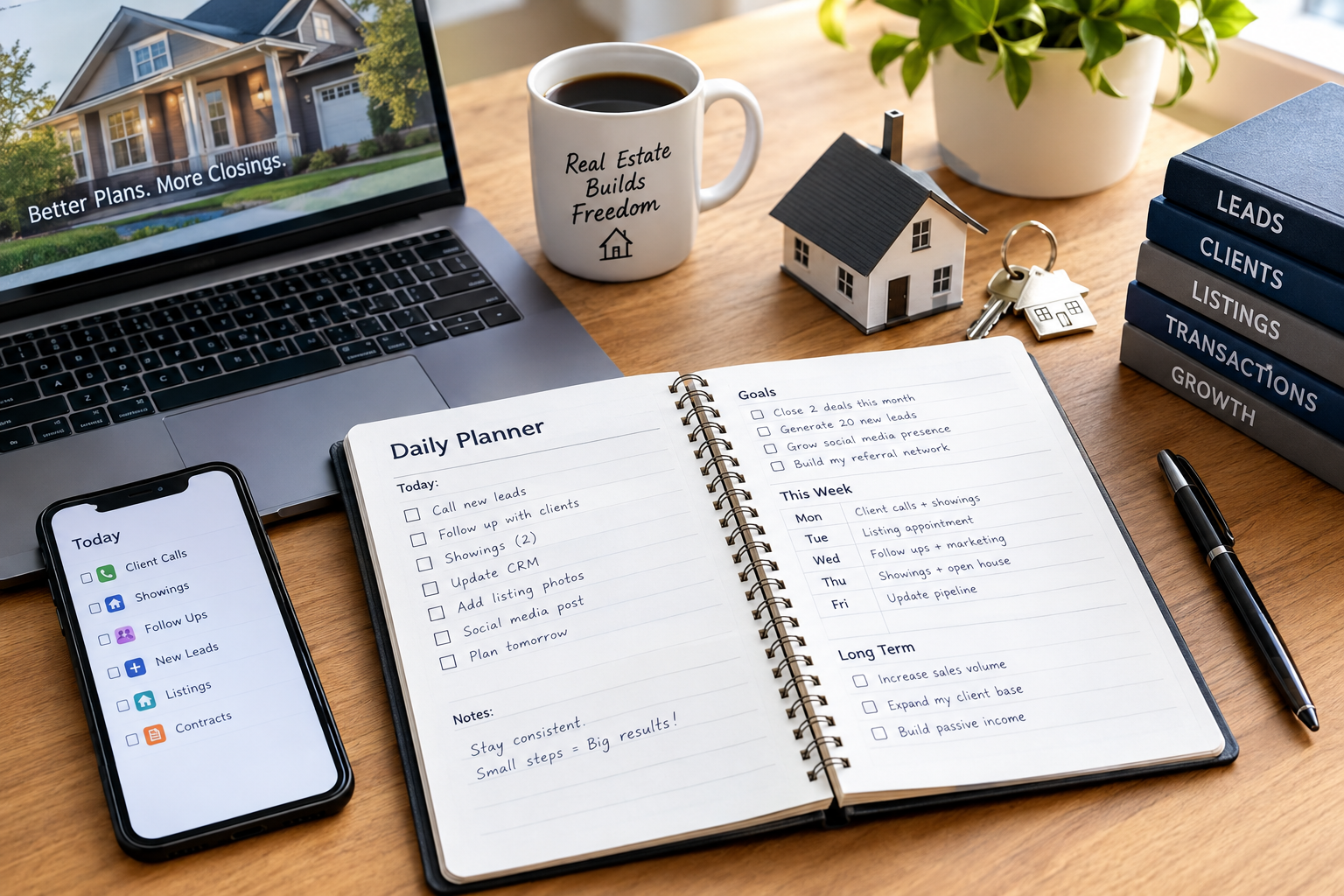
real estate agent planner, The most successful real estate agents share one habit that struggling agents consistently overlook: they operate from a plan, not from their inbox. A real estate agent planner is not just a calendar with a nicer cover. It is the operating system for your business—the tool that transforms vague ambitions like “sell more homes” into specific daily actions that generate commissions.
This guide goes beyond generic planner recommendations. You will learn what separates a planner that actually drives production from an expensive notebook, how to build a planning system tailored to real estate workflows, and which specific tools and templates top producers rely on.
Why Most Real Estate Agents Fail at Planning
The statistics paint a brutal picture. According to the 2025 NAR Member Profile, agents with more than 16 years of experience earned a median gross income of $78,900, compared to just $8,100 for those with two years or less . That gap is not explained by market conditions or territory. It is explained by systems.
Most agents treat planning as a January ritual. They set ambitious goals, download a template, and by February the planner is buried under a stack of contracts. The problem is not discipline. The problem is that generic planning tools are not built for the unique chaos of real estate work.
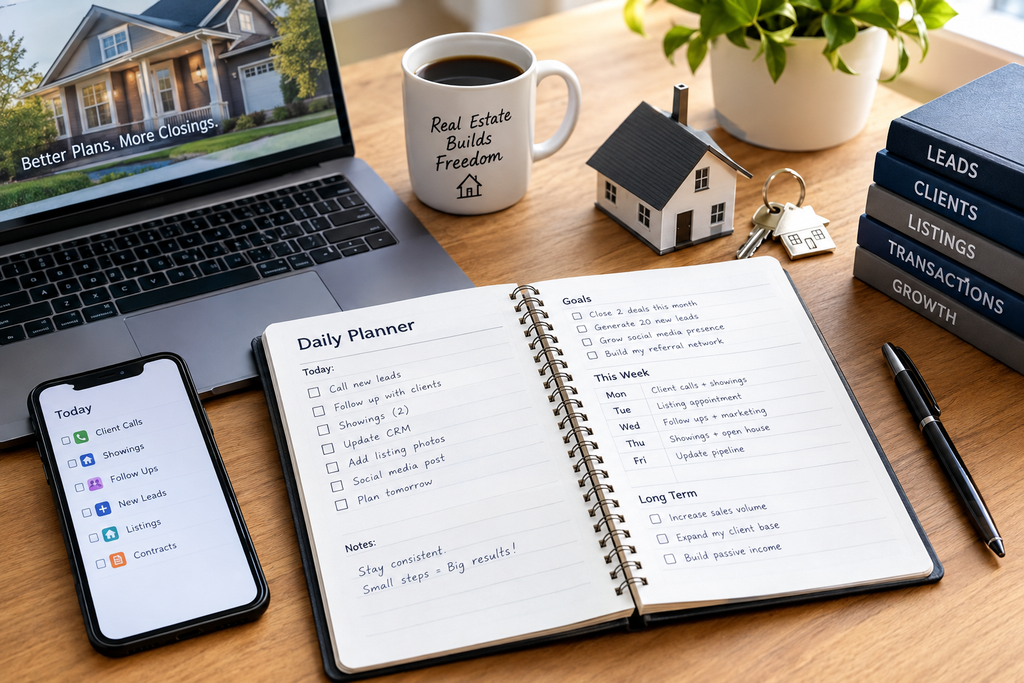
Real estate agents manage multiple clients at different stages simultaneously. A single Tuesday might include touring four properties, negotiating an inspection contingency over speakerphone, and drafting a social media post before the day ends . Paper planners fail because they cannot be rearranged when a showing cancels at 2 PM and a new one appears at 2:30. Phone apps fail differently—they silo information across calendar, notes, tasks, and CRM apps that do not talk to each other .
A real estate agent planner bridges this gap. It gives you the structure of a paper planning system with the flexibility of digital tools, all designed around how agents actually work.
The Three Types of Real Estate Agent Planners
Not all planners serve the same purpose. Understanding the categories helps you choose the right tool for your specific workflow.
Paper Planners Built for Real Estate Workflows
Paper planners remain popular for good reason. They force you to slow down, write by hand, and engage with your plan in a tactile way. The best real estate-specific paper planners go far beyond generic datebooks.
Consider what a comprehensive real estate agent planner includes: pending sales trackers with complete checklists from negotiation to closing, property and client information sections, lender and title contact fields, timeline date trackers for inspection periods and closing dates, and document checklists . Seller lead sheets capture all the information needed to list a property. Buyer consultation sheets ensure you and your clients are aligned before showing begins. Mileage trackers become lifesavers at tax time .
One agent in an industry forum captured the appeal of paper perfectly: “I use an AT-A-Glance planner. I know it’s old school but I have been using one for the last 19 years in this business. I can see my whole month at a glance and see where I can fit sometime in to my busy schedule. Many times I am booked days in advance and a phone just does not cut it for me” .
Digital Planners for Flexibility and Search
Digital planners solve the paper planner’s biggest limitation: rigidity. When your schedule shifts by the hour and you manage dozens of clients at different stages, the ability to rearrange, search, and duplicate pages becomes essential.
A digital real estate agent planner typically includes hyperlinked navigation, instant search across all pages, unlimited page duplication, and cloud backup . Agents use digital planners for open house scheduling (with prep checklists and visitor capture), client tracking (with running communication logs), deal pipeline visualization (tracking every deal through lead, showing, offer, under contract, inspection, appraisal, and closing stages), and daily time blocking .
The practical advantage is clear: you cannot search a paper notebook for a conversation you had with a buyer three weeks ago. You can in a digital planner.
Hybrid Systems: Planner Meets Business Plan
The most sophisticated approach treats the planner as an execution tool for a broader business plan. This is where the real estate agent planner becomes something more than a scheduling device.
A 30-minute business plan framework from Realtor.com demonstrates how this works. Start with your income goal, translate it into transactions required, identify your lead sources, then define the daily and weekly actions that will hit those numbers . For example, if you want $500,000 in gross commission income and your average commission per transaction is $10,000, you need 50 closings. If you close 10% of qualified leads, you need 500 leads for the year .
Your planner then becomes the tool that tracks those 500 leads and ensures you are making the daily contacts required to convert them.
What a Real Estate Agent Planner Must Include
After reviewing dozens of planner formats and agent workflows, certain features consistently separate effective tools from decorative notebooks.
Goal Setting with Financial Specificity
A planner that does not connect to your income goals is a hobby, not a business tool. The best planners include sections for setting goals around commissions, volume, closings, buyers, and listings . They help you work backward from annual targets to quarterly benchmarks to weekly activities.
The SMART framework provides the foundation: Specific, Measurable, Achievable, Relevant, and Time-bound goals . Instead of “sell more houses,” a SMART goal reads: “Close 20 transactions by December 31 with an average price point of $500K” .
Pending Sales and Transaction Tracking
Real estate agents juggle multiple transactions simultaneously, each with its own critical dates. A financing contingency expiration, an appraisal appointment, or a closing date missed can derail a five-figure commission .
Your planner should include dedicated space for tracking each pending sale through every stage. The most comprehensive systems include a complete checklist from negotiations to closing, with fields for property information, client details, lender, title/attorney, cooperating agent, inspector contact information, and timeline date trackers for acceptance date, inspection date, inspection period end date, and beyond .
Daily Time Blocking Structure
The highest-leverage habit in real estate is time blocking. It transforms vague ambitions into predictable movement . A planner designed for agents should support a daily structure that protects revenue-generating activities.
Top producers consistently protect a morning prospecting block—typically 60 to 90 minutes during peak energy hours—and defend it from interruptions . The rest of the day fills with follow-up, appointments, and administrative work. Without a planner that visualizes this structure, prospecting gets skipped when the day gets busy. And when prospecting gets skipped, leads dry up 30 to 60 days later .
Lead Source Tracking and ROI Analysis
A sophisticated real estate agent planner helps you understand which activities actually generate business. This means tracking calls, appointments, conversions, and closings by lead source . Over time, this data reveals which marketing channels deserve more investment and which should be abandoned.
Habit and Ritual Tracking
Real estate success is built on consistency. A planner that includes habit trackers, weekly goal reviews, and even journal prompts for mindset preparation creates accountability beyond task completion . The agents who earn $78,900 median income after 16 years did not get there through sporadic effort. They built systems that made consistent action inevitable.
The Daily Framework That Makes Planning Work
A planner is only as effective as the daily rhythm it supports. Here is a proven framework used by coaching programs and top producers.
The Morning Revenue Block
The single non-negotiable element of any agent’s schedule is a morning lead generation block. This is when you prospect, follow up with warm leads, and set appointments. Some coaches recommend an 8:00 AM to 9:00 AM “Input Hour” for market research and industry news, followed by a 9:00 AM to 11:00 AM revenue generation block for prospecting and outreach .
The principle is energy management: your brain operates at peak capacity early in the day. Prospecting calls, lead conversion conversations, and difficult negotiations belong in this window .
Midday Appointments and Showings
Client-facing activities fit best in the middle of the day when clients are available. A 1:00 PM to 3:00 PM appointment block accommodates showings, listing appointments, buyer consultations, and property previews . Batching appointments by geographic area and scheduling similar activities back-to-back reduces travel time and context-switching .
Afternoon Follow-Up and Admin
After appointments, a follow-up block ensures warm leads stay engaged. This is distinct from prospecting—follow-up serves people already expressing interest. Reply to comments on social posts, text past clients, check who is looking at property alerts .
Administrative work—updating your CRM, preparing offers, coordinating with lenders and title companies—belongs in a dedicated late-afternoon block. Batching admin tasks into one window protects revenue-generating activities throughout the day .
Evening Boundaries
Top agents stay accessible to clients while maintaining strong personal boundaries. A 7:00 PM to 9:00 PM window represents planned availability for urgent needs without actively prospecting or scheduling new activities . Automated responses and scheduled follow-ups keep leads feeling heard without requiring you to compose thoughtful replies at 10:00 PM.
Paper vs. Digital: Choosing Your Format
The paper versus digital debate misses the point. Both formats work. The question is which one you will actually use consistently.
Paper planners excel at tactile engagement and big-picture visibility. They work well for agents who think best with a pen in hand and who value seeing their entire month at a glance without swiping . The best real estate-specific paper planners include comprehensive transaction trackers, client information sheets, and commission tracking that generic planners lack .
Digital planners excel at searchability, flexibility, and integration. They work well for agents who manage high transaction volumes and need to find information quickly. Digital planners let you duplicate page templates for every new deal, search across all client notes, and access your plan from multiple devices .
Some agents use both: a paper planner for daily execution and goal visibility, with a digital system for transaction management and client communication logs.
Building Your Planning System: A Step-by-Step Approach
If you are starting from scratch or rebuilding a planning system that has failed, here is a practical sequence.
Step 1: Establish Your Income Goal and Transaction Math
Begin with your gross commission income target. Review last year’s numbers: total volume, average sales price, average commission . Set a goal that is ambitious but grounded in your actual production history.
Then reverse-engineer the transactions required. If you want $200,000 in GCI and your average commission per transaction is $8,000, you need 25 transactions. At a 3% conversion rate, that requires approximately 70 leads monthly, which translates to roughly 2 to 3 daily prospecting contacts .
Step 2: Identify Your Lead Sources
Choose three to five reliable lead sources and estimate how many leads each should generate. Common sources include your sphere of influence, past clients, referrals, open houses, social media, and online lead platforms . Too many sources spreads you thin. Too few leaves you vulnerable if one channel slows.
Step 3: Design Your Daily and Weekly Actions
A plan only works if it translates into specific daily actions. Identify three to five activities that directly move you toward your transaction goals. These might include prospecting calls, follow-up outreach, content creation, or appointment setting .
Step 4: Choose Your Planner Format
Match the planner to your workflow. If you need transaction trackers and client information sheets, choose a real estate-specific paper planner. If you need searchability and flexibility, choose a digital planner. If you need both, use a hybrid system.
Step 5: Build Accountability and Review Rhythms
Goals are easier to stick to when someone else knows about them. Share your targets with a mentor, broker, or accountability partner . Block monthly or quarterly review sessions to evaluate what is working and what needs adjustment. Small course corrections throughout the year prevent year-end surprises.
Common Planning Mistakes That Derail Agents
Even agents who commit to planning often make predictable errors that undermine results.
Planning without revenue math. A planner filled with appointments and tasks but disconnected from your income goal is just a busy calendar. Every activity should trace back to a transaction target.
Skipping prospecting when busy. This is the most dangerous mistake in real estate. When you skip prospecting because you are busy with active clients, you are borrowing from future revenue. Leads dry up 30 to 60 days later .
Confusing busy work with productive work. Organizing files that do not need organizing, attending meetings that could be emails, and excessive social media scrolling all feel productive but generate zero revenue. The 5-Minute Rule helps: if a task takes longer than 5 minutes but does not contribute to lead generation, deal closing, or client satisfaction, eliminate it or delegate it .
Planning without personal boundaries. A schedule that sacrifices sleep, relationships, and physical health for short-term production creates diminishing returns and eventual collapse. Block recovery and non-work rituals the same way you block client work .
Treating the plan as static. Real estate markets shift. Your business evolves. A plan that worked in Q1 may need adjustment by Q3. Monthly or quarterly reviews are not optional—they are how you stay aligned with reality.
Making Your Real Estate Agent Planner Work for You
The difference between agents who earn $8,100 and those who earn $78,900 is not talent or market timing. It is the daily discipline of operating from a plan rather than reacting to whatever appears in your inbox.
A real estate agent planner is the tool that makes this discipline possible. Whether you choose a comprehensive paper planner with transaction trackers and mileage logs, a digital system with searchable client notes and duplicate page templates, or a hybrid approach that combines both, the format matters less than the commitment to use it consistently.
Start with your income goal. Work backward to the daily activities that will get you there. Choose a planner format that fits how you actually work. Build accountability into your system. And protect your morning prospecting block like your commission depends on it—because it does.
Leave a Reply